As a child, I used to be a serious classical music snob. I viewed any music post-1900 with disdain (perhaps except for Holst), and certainly had no time for ‘popular’ music.
I’m not entirely certain where this obsessive love of classical music came from; certainly, my father played his share of classical tapes (and later CDs), and we would often listen to radio stations like ClassicFM, but he just as frequently listened to Bob Dylan, or U2, or even Indigo Girls (though I suspect this was pushed on him by my older sister). For myself, however, I lived in a world composed (so to speak) entirely of Mozart and Beethoven, Brahms and Bach.
I do remember enjoying films that used pop soundtracks, of course; Wayne’s World was one of the first exposures I had to pop music that I didn’t immediately tune out. Queen and Hendrix were certainly fun for a comedy movie, but it certainly didn’t prompt me to go out and buy their records.
No, I was entirely immersed in a world of pianos and orchestras, until a sequence of events unfolded that challenged my perception entirely. In high school, the head of the music department realized that there were no double-basses for the orchestra, and equally no bass guitar players who could read music. Somewhere I had found, or been given, a old bass that barely worked, and he taught me to play it so that I could perform the orchestra parts that would typically be played by the double-bass section. (The great thing was that I could turn up the volume to equal a whole double-bass section – and equally turn it right down if I hadn’t bothered to learn the part.)
It was around this time that another thing happened to me; something that would change my life forever. Around the age of fifteen, what I would later come to understand as bipolar disorder began to manifest itself as major depressive disorder. I chronically lost interest in everything, found myself in bed for hours or even days, and even began self-harming. For a time, it was impossible to see a light at the end of the tunnel.
With this lack of interest came a waning of the usefulness of classical music to me. What had unto that point been an escape of logic, precision and intellectualism became a prison of those same things that I no longer cared about. I needed something different – I just didn’t know it yet. I was drowning.
And that’s when the third thing happened. A senior in my school, also named Chris (I’ve long-since forgotten his last name, which is a shame considering the debt I owe him) saw that I could play bass, and asked me to join his band. With the invitation came a tape with three songs on it. Those three songs unlocked something in me. I remember it vividly: Black Night by Deep Purple, Sabbra Cadabra by Black Sabbath, and 1979 by Smashing Pumpkins.
At first I was skeptical. I went home. I put the tape on in my room, low volume. I listened. And then I listened again. And again. This was a sound I had never heard before, an entire experience I had never had. Lines like ‘Black night is a long way from home’ suddenly resonated with me in a way that no other words had. Black Sabbath had a heavy blues sound I couldn’t even define. And 1979 … it came with a nostalgia that brought me right back to my childhood, a trip to a happier place that at once made my depression worse, and simultaneously made it more bearable.
I wore that tape out. I needed more. I suddenly craved this new kind of music. This was also the heyday of P2P sharing services like LimeWire, and so I took to the burgeoning internet in search of something that would, somehow, make it possible to survive. I downloaded songs – bit by bit at first, as internet was not fast, but gradually by the dozens, then the hundreds – building a library of music that I suddenly found could speak. Music that told me I wasn’t alone. I soon discovered the darker side of rock; Metallica, and Marilyn Manson, and so many others – and it took off from there. I burned them onto CDs as playlists, and listened to them on repeat through each and every sleepless night.
I left the world of classical music behind, and drowned myself voraciously in rock and metal. And for more than twenty years, I stayed there. Sure, I would listen to the odd classical work from time to time; I hadn’t forgotten my appreciation of Western art music. But it was no longer my ‘jam’; I didn’t need it.
Which, more or less, brings us up to today. When I made the immense decision to leave my career behind and pursue a renewed education in music composition, I suddenly realized I might well be at a serious disadvantage – I knew absolutely nothing about the canon of contemporary classical music. All I knew was rock and metal. All I had cared about, for decades, was rock and metal. I even wrote metal songs for myself to listen to.
But as I navigate my way through 20th-century theory and Wagner’s impact on the world of opera, I’ve come to realize that I nonetheless have something to offer. A potentially unique perspective that I can bring to the world of classical music: a love of heavy metal.
There has been a fair amount of literature across the years on the subject of popular music, rock, and early metal to a degree; I remember reading Robert Walser’s Running with the Devil: Power, Gender and Madness in Heavy Metal Music from 1993 during my undergraduate studies. (He takes an often simplistic and overly misogynistic approach to the subject in my opinion.) But the heavier side of heavy metal; bands like Slipknot, Gojira, Meshuggah, and thousands of others are, I believe, almost entirely unrepresented in scholarly literature. And extreme metal – Dimmu Borgir, Behemoth, Cradle of Filth and Morbid Angel, to name just four – is utterly absent.
There are two things this inspires me to do. One is dive in the research of this kind of music. Learn about it, analyze it, and understand its impact and importance in the world. I believe there is a lot of interesting stuff going on here, from the massive orchestral flourishes of Nightwish to the intense polyrhythms of the entire ‘djent’ subgenre, there is ample room to expand the body of knowledge that surrounds this music.
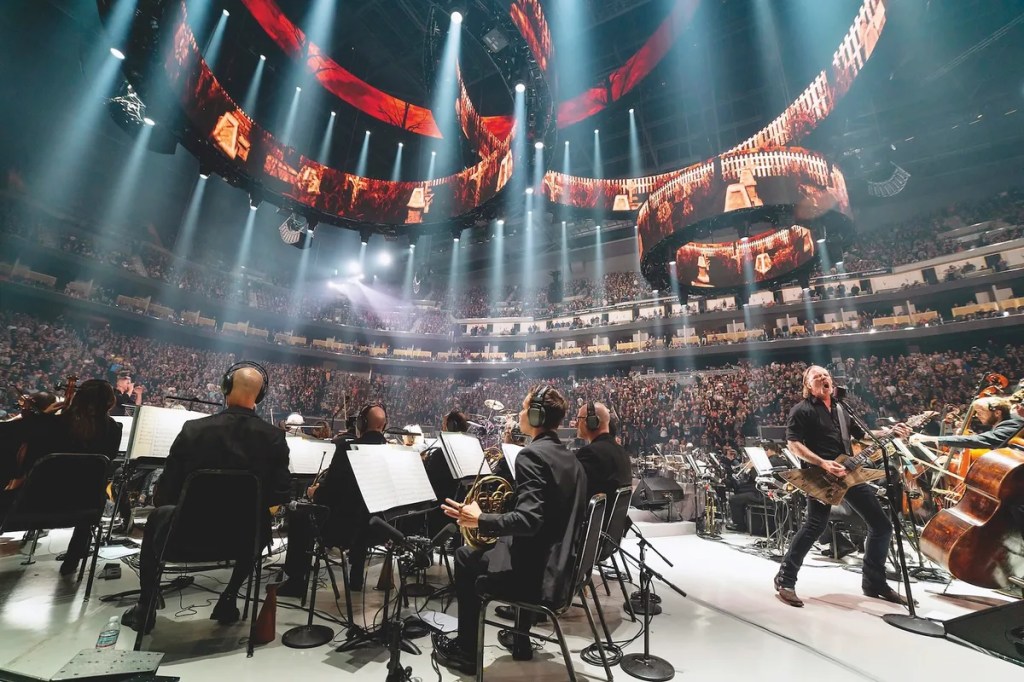
But more importantly, as a composer, I want to find a way to marry the two musical loves of my life: classical and metal. There have been many attempts at this over the years, from Deep Purple’s Concerto for Group and Orchestra to Metallica’s famous 1999 S&M concert with the San Fransisco Symphony Orchestra, to symphonic metal groups like Delain and Rhapsody of Fire. But these attempts have almost always been unidirectional; take heavy metal and add classical touches. I want to do something different. I want to, on a fundamental level, combine the textures and elemental aspects of both styles of music in a way that makes them completely inextricable.
I had already started to do this before beginning my Masters degree; I’ve written (or composed) three albums of what I would dub ‘classical metal’. The first is simply for a heavy metal band, but the form is that of a classical symphony: four movements, totaling over an hour of music collectively. The second began to incorporate elements of classical orchestra: a five-song album (also close to an hour) in which extended passages are entirely orchestral, and in the places where metal and orchestra meet, I’ve attempted to make them so complimentary that one would not suffice without the other. The third, which I completed a few years ago, comprises a single, hour-long song, split into 19 separate tracks, which again combines orchestra, choir and metal in perhaps the most cohesive manner I’ve managed so far.
As I learn more about classical orchestration, tonality, structures and forms, I realize that these albums represent only the beginning of my musical journey. I envision in my future works that could be performed live – entire symphonies of metal and orchestra. Earlier this year I had the seed of an idea for an opera of metal and orchestra. This is an element that I, at least, have never encountered in the world before.
It’s time to rock the classical concert halls.
 The Revenant Composer
Leave a comment